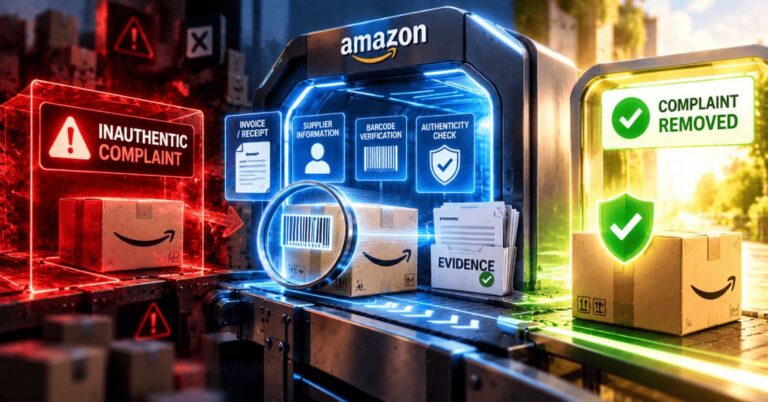
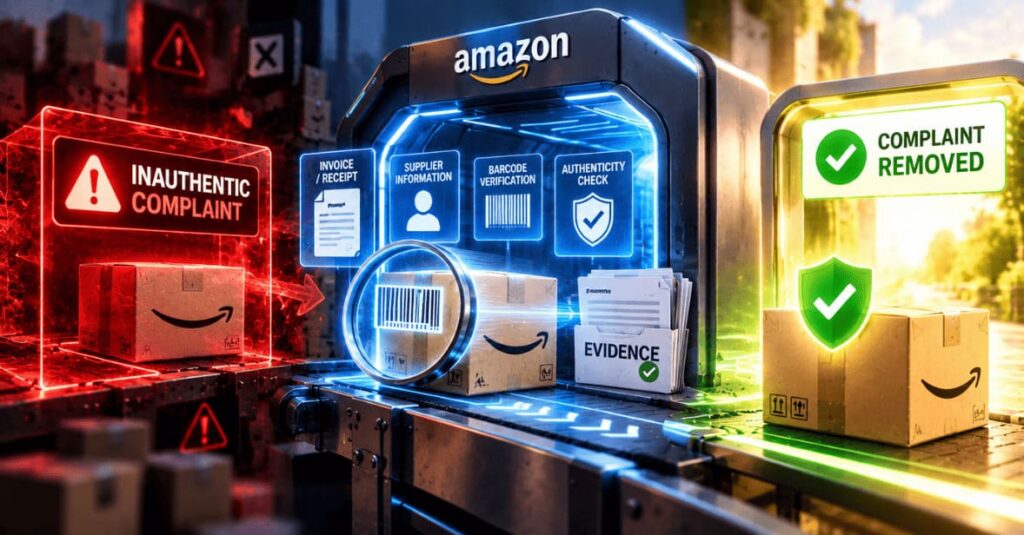
An Amazon counterfeit complaint and an inauthentic complaint can produce the same panic: the listing disappears; your account becomes deactivated; your funds are withheld; your FBA inventory cannot be sold or removed; and Amazon asks you to prove something about a product you sold months ago. Counterfeit and inauthentic complaints are not the same, and sellers frequently lose their appeals because they believe the terms are interchangeable. Counterfeit complaints are submitted to Amazon by brand owners as an intellectual property claim. Inauthentic item complaints are triggered by poor customer feedback or Amazon’s own algorithms. These are, essentially, supply chain concerns.. The deactivation notice issued by Amazon should clearly state whether the concern is about counterfeit goods or inauthentic items. Identifying the concern helps you identify the appropriate evidence. Our counterfeit complaint attorneys handle both.
Counterfeit vs. Inauthentic: Two Different Problems
A counterfeit complaint normally comes from a brand owner using Amazon’s intellectual property infringement reporting tool or Brand Registry. A counterfeit complaint is an allegation that your product is an unauthorized reproduction (i.e., fake). Trafficking in counterfeit goods is a violation of trademark law (the Lanham Act) which can expose a seller to civil litigation. It is also a violation of criminal law which can carry significant consequences.
An inauthentic complaint normally comes from Amazon, often after customer/buyer messages, feedback, or returns. Customer feedback can be found under Voice of the Customer within Seller Central or feedback/reviews on your Product Detail Pages. Amazon isn’t necessarily calling your goods fake, but it wants to know where you acquired them from.
| Counterfeit complaint | Inauthentic complaint | |
| Who raises it | The rights owner, through Amazon’s reporting tools | Amazon, often after excessive buyer complaints or returns |
| What it alleges | Your product is an unauthorized reproduction or a “fake” | There are potential concerns about your supply chain |
| Main resolution route | A retraction from the rights owner, or acceptable evidence such as invoices, letters of authorization, licensing agreements | Invoices and complete supply chain evidence |
| Added legal exposure | Demand letters, federal litigation, Schedule A cases, possible criminal prosecution, forfeiture of Amazon funds | Deactivation of your Amazon Seller Account, confiscation of your funds, destruction of your FBA inventory |
Why Did You Receive an Amazon Counterfeit or Inauthentic Complaint?
Complaints rarely come out of nowhere. One of the following usually triggers the issue:
- A customer questioned product authenticity. A buyer raised doubt in a message, a review, or a return reason.
- Your product does not match the listing. A variation, a model year, or a bundle differs from what the Product Detail Page.
- Your product packaging or branding appears different. Regional or national packaging, a rebrand, or a relabeled case pack can look wrong to a buyer comparing it against the brand’s own images.
- Your supplier or sourcing documentation is incomplete. You have invoices but they lack critical information or they do not establish the products’ complete chain of custody as required under Amazon’s Responsible Sourcing Documentation Request Requirements Policy.
- A rights owner reported you. A brand filed a counterfeit complaint through Amazon’s reporting tools, sometimes across all third-party sellers of the same ASIN.
- You received multiple authenticity complaints. Repeated authenticity concerns raised by customers across a variety of ASINs over a relatively short period of time.
- Amazon identified an authenticity concern during review. A routine audit, a verification sweep, or a Transparency or Project Zero check flagged your goods as potentially inauthentic.
You must determine the correct issue, gather your evidence, and proceed through the appropriate resolution path.
What Happens to Your Listing, Inventory, and Funds
Amazon removes the affected listing immediately. Depending on your account history and the severity of the claim, Amazon may deactivate your e account, withhold disbursements while it reviews your appeals, and destroy or confiscate your FBA inventory (including inventory not impacted by the complaint). The complaint also stays on your Account Health record, so deleting the listing removes neither the complaint nor its effect.
Before Anything Else: Do Not Touch Your Documents
A seller receives a counterfeit or authenticity complaint. It compares its invoice with Amazon’s requirements and determines the invoice is missing critical information. The seller manually edits the invoice to insert missing or incorrect information. DO NOT DO THIS. This is fraud and forgery. You’re now dealing with a product authenticity issue and a document manipulation/forgery issue. Your path to reinstatement is now virtually non-existent.
You can redact pricing, but you cannot add, remove, or modify documents to reflect date changes, product quantities, or supplier details. If your documents do not contain all information requested by Amazon, go back to your supplier for proper documentation rather than improving the paperwork yourself. And make sure you save all the communications between you and your supplier in the event Amazon accuses you of document manipulation.
What Amazon Expects Your Invoices to Show
Amazon treats an inauthentic complaint as a question of provenance, so your response stands or falls on documentation. It generally expects invoices that:
- Issued within the last 365 days
- Clearly identify the supplier, its name, address, phone number, and website or email address
- Name you as the buyer, matching the business name and address on your Seller Central account
- Cover the quantity you sold during the period in question
- Describe products that clearly match the ASIN under review
- Trace your products all the way to the brand or manufacturer in accordance with Amazon’s Responsible Sourcing Documentation Request Requirements Policy
Amazon may contact your supplier directly. This makes supplier vetting and due diligence an extremely important component of selling on Amazon. If your supplier is not legitimate or otherwise fails to ignore Amazon’s outreach, then Amazon will deem your supplier “unverifiable” and refuse to reinstate your account.
Retail receipts, online arbitrage order confirmations, packing slips without supplier details, and proforma invoices all fail verification for the same reason: they don’t prove a traceable commercial purchase. A Letter of Authorization evidences a brand’s permission for you to sell, not where your units came from, so it supplements invoices rather than replacing them.
Responding to a Counterfeit Complaint From a Rights Owner
Amazon will not override a brand’s complaint just because you disagree. Only the rights owner can withdraw it, which leaves two realistic paths: persuade the brand to retract, or submit evidence that your goods are genuine and lawfully sourced.
Treat contact with the rights owner as contact with an opponent. A well-judged approach resolves some complaints quickly. A careless or aggressive approach rarely results in a retraction.If you suspect a counterfeit complaint is erroneous then it is recommended to have counsel approach the rights owner. If the complaint concerns branding or images rather than product authenticity, our guide to trademark and copyright complaints covers those routes.
Responding to an Inauthentic Complaint From Amazon
A response to an inauthentic item complaint must be evidence-based. Amazon no longer accepts Plans of Action for product authenticity cases. You must obtain and maintain invoices tracing your products to the brand or manufacturer in accordance with the Responsible Sourcing Documentation Request Requirements Policy. While there are exceptions, failure to provide Amazon with acceptable supply chain documents from a legitimate and verifiable source is usually a death knell to reinstatement.
When the Complaint Is Wrong or Filed in Bad Faith
Some complaints function as anti-competitive tactics rather than genuine brand enforcement, and Amazon provides a route for reporting suspected abuse of its reporting tools. Build that argument on evidence. An unsupported accusation of bad faith weakens everything else in your response.
When a Counterfeit Allegation Becomes a Legal Case
Counterfeit claims escalate in ways inauthentic claims usually don’t. A brand may send a demand letter or file a federal intellectual property infringement suit. In Schedule A cases, a rights owner sues many sellers together and seeks a temporary restraining order that freezes Amazon account funds, sometimes before the sellers even know they’ve been sued. Court deadlines don’t extend because you’re still appealing, so Schedule A defense starts the day the papers arrive.
How Amazon Suspension Lawyer Handles These Complaints
We classify the complaint and audit your documentation to determine whether it complies with Amazon’s requirements. From there we manage any rights owner communications or written appeals.Leo A. Vaisburg, Esq. and his team lead this work. Outcomes depend on your evidence and account history, and no firm can promise a removal.
Frequently Asked Questions
What is the difference between a counterfeit and an inauthentic complaint on Amazon?
A rights owner files a counterfeit complaint alleging that your product is an unauthorized reproduction or “fake.” Amazon issues inauthentic complaints after buyers complain or leave excessive negative feedback. Counterfeit complaints and inauthentic item complaints have different resolution paths.
What invoices does Amazon accept for an inauthentic complaint?
Amazon requires invoices issued within the last 365 days showing the supplier’s name, address, phone number, and website or email, buyer details matching your Seller Central account, quantities covering the units you sold, and product descriptions matching the ASIN. It may contact the supplier to verify. Retail receipts and online arbitrage order confirmations usually fail.
Can I edit my invoice before sending it to Amazon?
You may redact unit prices. You may not change dates, quantities, supplier information, or buyer details. Amazon treats document manipulation as one of the most serious violations.
Will removing the listing make a counterfeit complaint go away?
No. The complaint stays on your Account Health record, and relisting under a new ASIN invites additional enforcement. Counterfeit complaints can also continue outside Amazon through demand letters or litigation.
Send the Right Evidence, in the Right Words
Your documents and your explanation both outlive the appeal. Amazon reads them now; a rights owner may read them later. Have your counterfeit or inauthentic complaint reviewed before either one goes in.